lunes, 31 de enero de 2011

E-books rule: the growing of an e-empire.

Barnes & Noble shares drop by 16% after warning of weak profits.

Barnes & Noble is suffering in the switch away from books.
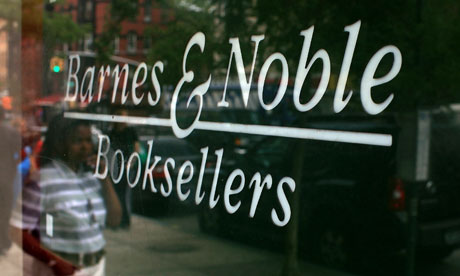
Barnes & Noble in New York. 
Barnes & Noble in New York. Photograph: Spencer Platt/Getty Images.
 
A shift in literary tastes from books to digital reading devices has hurt America's biggest high street bookseller, Barnes & Noble, which saw its shares slump 16% on Wall Street on a warning of weak profits.

Barnes & Noble, a stalwart of the books industry which has 720 high street shops in the US, revealed a $32m (£21m) loss for the three months to May following a 3% drop in like-for-like sales at its bricks and mortar stores. The company conceded that investment in e-books would hit earnings in the year ahead.
"We are planning to redirect a significant portion of our financial resources towards investments in technology, sales and marketing," said chief executive William Lynch. "These investments will impact our bottom line in 2011, but we believe they will enable Barnes & Noble to capitalise on the significant mid-to-long term growth opportunities presented by the digital markets."

In common with others in the industry, Barnes & Noble is hoping that downloads of digital books, plus mail-order sales from its website, will make up for a decline on the high street.
The company believes it can win a quarter of the digital books market and has set a target of group-wide sales of $8.9bn in 2014, compared to last year's $5.8bn.
However, some feel this is optimistic. Michael Souers, an equity analyst at Standard & Poor's, said: "There's a risk inherent in switching strategies and there is significant investor concern about how long it will take to monetise the e-books strategy."

The slump in Barnes & Noble's share price put the stock at its lowest point since late 2008. Others in the industry are also suffering. Rival chain Borders recently refinanced its debt to stave off the prospect of bankruptcy. On the internet, Wal-Mart and Amazon have engaged in price battles offering deep discounts on bestselling books.


 As people who live surrounded by techonology and its supremacy, we may not see-at first- the significant consequences of "marvellous" e-books. That is why we decided to add this article from The Guardian. Though it dates back to June 2010, it is a reality present all around the world.  

 A second attention-grabbing article recently published shows important numbers about the demand on e-books. We invite you to click on it! 


 Feel e-welcome and free to e-comment on any of the articles published on the blog :) Thank you!


jueves, 27 de enero de 2011

Traditional teaching vs. new technology

It seems that new technology has totally removed old tools of traditional teaching. Everybody talks about the ICT in the classroom and those schools that make no use of digital blackboards are "old fashioned" and their teaching method is considered "poor". However, in these times, it is not that easy to provide all schools with new materials and the latest technology. There are some Secondary Schools in Valencia, for example IES Sorolla, where teachers are forced to use old-fashioned radio cassette players and, if they are lucky that nobody is using the audiovisual room, then they can bring their students there and do some interactive exercises or some listening tasks. But that room is always overbooked so it is difficult to get there.
It is obvious that there are no fundings in education and even less in new technology... So, how can teachers working in that conditions deal with students' motivation and make their lessons interactive and exciting?

E-books or paper books?

We all know that e-books are becoming more and more famous at the speed of light.
Both e-books and paper books have different formats but they are used for the same purpose: they allow you to read a book. If you want an e-book you just have to download the book you are interested in and save it in you e-book reader, whereas if you want to read a traditional book, the paper one, you just have to go to a library, buy one or borrow one from a public library.
E-books are currently very trendy. I haven’t got an e-book reader and I think I will never have, because I am a paper books lover, but a lot of friends of mine, who are students too and love reading, have decided not to buy paper books anymore. They say buying an e-book reader it’s expensive at first, but then you recoup the cost of it very quickly.
You can download as many as you want. They are easily portable, therefore your bag won’t be heavy with all those things you carry in it and you won’t be killing more trees.
But paper books have advantages too. They are good gifts. It is also nice to have them in a bookshelf and you can buy them anywhere and they don’t need power to work.
If you are student you will also understand how important it is for a student to write some notes in them!
So it’s up to you. Tell me, what do you use?